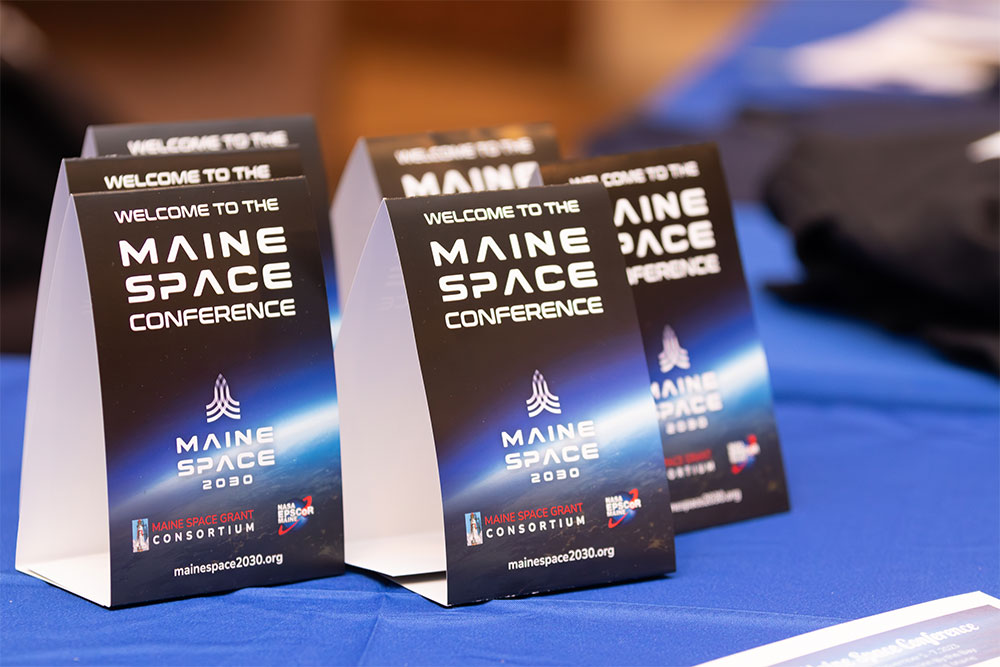


Maine Launch Summit
The 2026 Maine Launch Summit is November 5-6, 2026, at the Northeastern University’s Roux Institute, 100 Fore Street, Portland, Maine.
From thought-provoking discussions to inspiring presentations, the conference showcases the incredible talent and innovation shaping our space community. Stay tuned for more details about this year’s conference—we can’t wait to continue this journey with you!
###ONLINE REGISTRATION IS NOW CLOSED### There are still spaces available, but registration is now in person at the Maine Launch Summit.
Book your hotel room: Maine State Space Corp Booking Link
View Summit Agenda: November 5; November 6
Maine Launch Infrastructure & Space Ecosystem Summit
Determining Maine’s Preferred Launch Architecture and Space Economy Strategy
Location: The Northeastern University’s Roux Institute, 100 Fore St. Portland, Maine. Reception venue TBA.
Organized By: Maine Space Corporation
The Maine Space Corporation is convening a one-day strategic summit (followed by a 1 day Maine Space Supply Chain meeting) to identify the launch infrastructure, supply chains, and support services that will position Maine as a leading participant in the North Atlantic space economy.
Nov 4: Welcome reception and early registration, 5-7 Shipyard.
Nov 5: 8:00 AM to 5:00 PM. INVITATION ONLY, limited to 100 participants. Reception at Brickyard Hollow following, with participants and sponsors ONLY. There is no cost to invitees for this day or reception.
Nov 6: 8:00-4:00. Open to the public. Limit: 320 attendees.
The November 5th summit will evaluate three potential development pathways:
Architecture A: Land-Based Spaceport Ecosystem
A fixed launch facility supported by manufacturing, testing, integration, logistics, workforce development, and mission support services.
Architecture B: Sea-Based Launch Ecosystem
A maritime launch capability leveraging Maine’s ports, shipbuilding expertise, offshore operations experience, and marine engineering capabilities.
Architecture C: Air Launch Ecosystem
A model featuring land / airport / lift aircraft. Integration, testing, mission operations, and manufacturing facilities supporting offshore launch operations.
The objective is not simply to identify where launches occur, but rather to determine the ecosystem that will generate the greatest long-term economic value, workforce opportunities, strategic partnerships, and commercial competitiveness for Maine.
Desired Summit Outcome
By the end of the summit, Maine will have a clear, actionable framework for developing a launch ecosystem that leverages the state’s unique strengths in aerospace, maritime operations, advanced manufacturing, workforce development, and innovation, while establishing a roadmap for future investment and growth, and further actionable items to be identified at follow on meetings in May and October of 2027. Dates TBA.
Commercial Space Industry
- Launch providers
- Satellite operators
- Aerospace manufacturers
- Mission operations providers
Maritime Industry
- Shipbuilders
- Port operators
- Marine engineering firms
- Offshore operations specialists
- Maine Maritime Academy
Government
- State agencies
- Federal agencies
- Economic development organizations
- Legislative leaders, State and Federal
Research and Education
- University of Maine System Space Engineering and Offshore Wind Educators / Developers
- Maine Community College System
- Maine Maritime Academy
- Research institutions
- Workforce development organizations
Investment Community
- Bond issuers / Brokers utilizing recent Tax Exempt status of Space Ports
- Infrastructure investors
- Venture capital organizations
- Economic development finance entities
Day 1 Panel Descriptions
Panel 1 – Establish Launch Site Criteria per Launch Modality, 09:30-10:45
The Maine Space Corporation has identified three different launch modalities: land, sea,
and air. Land refers to shore-based vertical launch, sea refers to vertical launch from a
mobile marine platform, and air refers to a rocket that launches from an aircraft at
altitude. This session will identify the common and unique criteria for the three launch
modalities. We will use the criteria in the afternoon session to prepare the spaceport
development plan.
Panel 2 – Space Industry Ecosystem Overview, Including Launch and Reentry, 11:00-
12:15
No spaceport exists in isolation; it operates within and serves a larger ecosystem.
Before the Maine Space Corporation delivers unparalleled space access through three
launch modalities, it must identify the current ecosystem into which it will introduce the
spaceport. This session will frame the current demand for Maine’s spaceport and look at
recent infrastructure and ports projects to drive planning considerations.
Panel 3 – Launch Modality Comparison: Land-Sea-Air, 13:00-14:30
Three launch modalities yield three different business models along with their distinct
operating procedures and planning considerations. This session will compare the land,
sea, and air launch modalities to evaluate which one offers the more compelling starting
point.
Working Group – Drafting the Spaceport Development Plan, 14:45-16:45
The data developed during the first three panels all lead here. First, we built the list of
criteria to inform the planning process. Next, we verified that the spaceport adds value
by considering the broader space ecosystem. Finally, we compared and contrasted the
launch modalities to consider which one is the better starting point. In this session, we
will draft the spaceport development plan which will include a rough timeline and specific milestones such as first demonstration launch, first space access license, first commercial launch, etc.
Day 2 Panel Descriptions
Panel 1: Manufacturers’ Capabilities Exchanges
This panel will give very brief lists of capabilities/experiences. “Lightning round robin”.
Panel 2: How Should the Maine Space Corporation Serve Manufacturers?
As the spaceport becomes operational, it will attract more space companies to Maine, many of
whom will be interested in buying from the 90 or more space companies already in the state.
The Maine Space Corporation wants to learn directly from space manufacturers what it can do to
serve them. John Karp will solicit feedback from those gathered. What do you want the Maine
Space Corporation to do for you? Is it assistance with public or private finance to fund
expansion? Access to space talent moving into the state? Coaching on regulatory
compliance? As a non-profit, the options for advocacy may be limited; please bring your
ideas to help shape what the future of space looks like in our state.
Working Lunch; Report Outs
Having identified the needs of space companies in the last panel, divide into groups for lunch
to discuss the various categories and report the outcomes of those discussions to the larger
group.
Panel 3: Doing Business in Maine: Government Support to the Private Sector, Tax Incentives; Financing
This panel covers the assistance Maine provides to companies in the state, including tax
incentives for startups, expansion, and certain investments in early-stage companies. It will
also cover some of the financing options available to Maine companies, including the role that
spaceport bonds will play.
Panel 4: Space Supply Chain Security Concerns
Space companies are responsible for securing their operations, perhaps more than most
industries. This panel will highlight physical and cybersecurity issues space companies face.
| Agenda November 5th INVITATION ONLY | ||
|---|---|---|
| Time | Session | Primary Outcome |
| 8:00-8:45 AM | Registration, Networking, Coffee with Snacks | Initial networking opportunity and open discussion of “Pre Work” items. |
| 8:45-9:30 AM | Welcome, Dawn DiBlasi, Esq. / Maine Space Corp Board Chair Keynote Mr. Mark Bontrager / USSF Space Access Advisor & Summit Charge, John Karp, Executive Director, Maine Space Corp. | Align objectives and desired outcomes. |
| 9:30-10:45 AM | Panel 1 – Establish Launch Site Criteria per Launch Modality. | Adopt weighted scoring criteria. Values to Maine. |
| 10:45-11:00 AM | Break | |
| 11:00 AM-12:15 PM | Panel 2 – Space Industry Ecosystem Overview: Launch, Reentry | Brief legal education re Space, Compare Land-Based, Sea-Based and Air launch ecosystems. |
| 12:15-1:00 PM | Working Lunch discussion to identify the highest-value economic opportunities | Identify highest-value economic opportunities. |
| 1:00-2:30 PM | Panel 3 – Launch Modality Comparison: Land-Sea-Air | Develop initial ecosystem blueprints. |
| 2:30-2:45 PM | Break | |
| 2:45-4:45 PM | Working Group - Drafting the Spaceport Development Plan | Identify key challenges to progress |
| 5:00-7:00 PM | Reception, joined by sponsors | Brickyard Hollow 9 Commercial St. |
| Agenda November 6th: Open to Public | ||
|---|---|---|
| Time | Session | Primary Outcome |
| 8:00-8:30 AM | Coffee and Snacks | |
| 8:30-9:00 AM | Welcome and 2 Keynotes | Ed Polewarczyk, Former United Space Alliance Shuttle Program Rep, Steve Violette, Lead Thermal Engineer, Fiber Materials / FMI Industries |
| 9:00-9:45 AM | Summit Charge; Mfg capabilities pitches | John Karp, Daniel Griesen |
| 9:45-10:00 AM | Break | |
| 10:00-10:30 AM | Manufacturing capability pitches | |
| 10:30-11:15 AM | Manufacturers inputs: Needs to grow in the Space Supply Chain | Moderator: Daniel Griesen / Griesen Aerospace; Trevor Hehn / Hehn Law, Mike Nachshen, Fortis Strategies |
| 11:15 AM-12:00 PM | How should MSC serve Mfgs, Moderator: John Karp | List of actions to answer manufacturer needs. |
| 12:00-1:00 PM | Working Lunch Session / Groups formed. How to market Maine to Space Industry? 2-4 groups depending on topics. Facilitator for each group: Daniel Griesen, Trevor Hehn, Tom Wyel, Mike Nachshen, Fortis | Identify highest-value Space Industry marketing opportunities for Maine manufacturers. What role should MSC play in this? |
| 1:00-1:30 PM | Report-outs from groups; moderated by John Karp | Directive to Maine Space Corp for actions. |
| 1:30-2:30 PM | Doing Business in Maine: Gov/private sector support, Tax Incentives, & Financing | Moderator: Ben Sturtevant; Tom Wyel MTI, Maine & Co., FAME, MITC, MVF |
| 2:30-2:45 PM | Break | |
| 2:45-3:30 PM | Space Supply Chain Security Concerns | Moderator: Tom Vanek; Jim Macisso, Chris Torino, Monarch ISC. |
| 3:30-4:15 PM | Summit review, final speaker, closing. | Industry big picture learnings. |
| 4:30-6:30 PM | Networking social. | Brickyard Hollow or other pubs (on your own) |